Wednesday, February 18, 2015

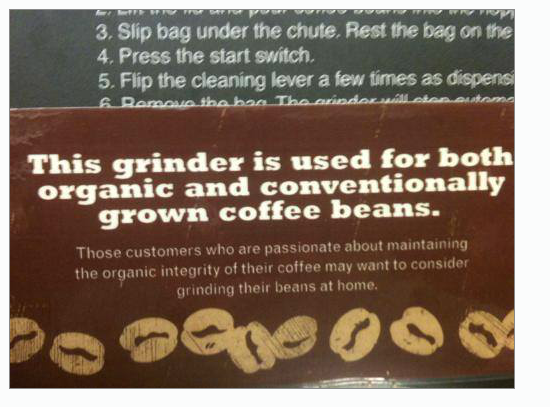
Is this a form of Compulsive Disorder?

I read some time ago that people who have an aversion to math may be less able to understand topics linked to GMOs and other health-related information. This was revealed by researchers at Penn State University. It might be due to their lack of understanding of statistics.

I always felt that there are many reasons for being anti-GMO. Ignorance or lack of knowledge on science, driven by business motives (such as pro-organic, funding from chemical and pesticide companies), genuine concerns on food and environmental safety (though it is unfounded), influence from green NGOs (due to inability to distinguish between science and pseudoscience), and for some it is a cult/religion which they follow blindly.

Here I found a new reason – some sort of compulsive disorder. Just look at the pictures below.


These people need medical help….


By Dr Mahaletchumy Arujanan

Because science has its ‘wow’ factors!

LAST month we launched a new-look The Petri Dish – with a refreshingly new masthead, layout and font types. This breezy new look is accompanied this month by the introduction of a special pull-out –  SCOPE.
 
So now, The Petri Dish comes in 20 full-colour pages. This is 67% increase in the number of pages since The Petri Dish was first launched in Feb 2011.
 
The SCOPE will feature the “wow” factors of science exploring the Why, What, When, Where, Who and How of Science. This is our offering to a wider range of readers, especially the school going intelligentsia and  younger readers to get them into the world of science.
 
We hope to have your continued support to bring science to the schools in a fun and breezy way. Share with us mind-blowing facts that you stumble upon and want others to know about it. Together let us make science infectious and enjoyable.
 
The latest statistics on the Global Status of Biotech/GM Crops was just released by the International Service for the Acquisition of Agribiotech Applications (ISAAA). We bring that to you in this issue. See lead story in the front page and in pages 6 &7.
 
To date there are 18 million farmers commercially growing 181.5 million hectares of biotech/GM crops in 28 countries. What drives this technology is the reduced use of chemical pesticides by 37%, increase in crop yield by 22 % and increase in farmer profits by 68%.
 
Three new crops approved in 2014 were Bt brinjal in Bangladesh (resistant against brinjal fruit borer), drought –tolerant sugar cane in Indonesia and potato in the USA with reduced acrylamide content when deep fried and resistant to browning upon peeling. 
 
The Bt brinjal and drought-tolerant sugar cane are products of public sector, much to the contrary of claims by anti-GM NGOs that GM crops are monopolised by big industry players. These are fruits of sheer determination and political will and evidence that developing countries can take the lead too.
 
Wishing all our Chinese readers, advertisers and subscribers a very prosperous Chinese New Year as the Year of the Goat bleats into 2015.    


By Dr Mahaletchumy Arujanan

Wednesday, February 11, 2015

Is DNA a bad word?

Americans have been voting in every States on whether they do or don’t support mandatory labeling of GM foods. While a majority supports labeling, how much of the decisions made at the ballot box are based on knowledge and understanding of biotech remains a question.

I came across two surveys which strengthen my observation that the public is not making a well-informed decision. It is just based on gut feeling, bad press on GMOs and influence from the scaremongers that GM is bad for us.


Watch this video
The summary of this video: I don’t know what are GMOs but all I know is it is bad for me.
My  question: Don’t we study the topic in hand a little before making a decision? What makes these people jump into conclusions?

 Dr Mahaletchumy Arujanan discussing GM foods with members of Gardening Society in Kuala Lumpur who were predominantly anti-GM

Another survey done by Oklahoma State University:

86.5% of respondents support mandatory country of origin labels for meat. A large majority (82%) “support mandatory labels on GMOs”. But curiously, about the same amount (80%) also “support mandatory labels on foods containing DNA.”

It reveals that these people do not have any understanding of what DNA and GMOs are. And this is why the GMO critics have an upper hand with the public as it is easy to create scary looking foods and paint a negative picture about GM foods.

Second thoughts: The 80% who wants all foods containing DNA to be labeled might be right after all. All our foods are modified genetically anyways.

By Mahaletchumy Arujanan

Monday, January 26, 2015

On to a New Year With Renewed Hope

HAPPY New Year to all our readers! We hope that everyone had wonderful holidays and are back energised and inspired to kick start 2015. It is almost four years since we started publishing The Petri Dish amid skepticism whether or not a science newspaper can be sustained in Malaysia. The main reason behind its success is every one of you who have been giving us positive feedback and encouragement. The Petri Dish has grown in readership from 6,000 when we started in Feb 2011 to 18,000 today. It is subscribed by all the key biotechnology institutions in Malaysia and is available to cabinet members, chief ministers and to the general public. To start 2015 afresh, we have given a creative facelift to The Petri Dish. Hope you enjoy the new look. We are not stopping here. Wait for yet another announcement soon in our attempt to get the public interested in science and its phenomena. We are introducing a new section called “Biotech in Focus” which is reproduced with permission from University of Hawaii. Prof Ania who produces this is a good friend of mine and I am impressed on how she simplifies GM technology and dissects topics related to GM crops and agriculture. We hope this will help shed some light on the highly controversial issues surrounding GM crops. We take this opportunity to thank all our readers, subscribers and columnists for your support and trust we can continue to count on you to transform The Petri Dish into a mainstream media. It is also our hope and dream that more scientists will come forward to talk about their research and bring it to the wider world beyond scientific journals and conferences. Join us in this exciting world of science communication and enriching scientific knowledge of the public.


By Dr Mahaletchumy Arujanan

Spreading the Science-bug For the Making of a Science-literate Society

AS the year comes to an end, it is time for some reflection and stock taking. As for many, 2014 was an extremely busy and fruitful year for us at The Petri Dish. We became the official media for BiotechCorp to disseminate information on the Bioeconomy Transformation Programme. Through BiotechCorp, The Petri Dish now has readers at the corridors of power, reaching out to all cabinet members and chief ministers.

In order to promote public sector research and bring it out of the ivory towers, we introduced Research  Digest. We hope public universities and research institutes will continue to support by providing content for this section. It is time for home-grown research to be glorified.

This year, we covered a number of prominent events and provided on-site reports. BIO San Diego in the USA, BIO-IAP in New York, Meeting of the Parties to the Cartagena Protocol on Biosafety (MOP7) in South Korea and BioMalaysia 2014 in Kuala Lumpur were some of the events covered.
I can promise that 2015 is not going to be short of any breakthroughs for The Petri Dish. As a start we are increasing the number of pages from 16 to 20. The extra pages will complement the current Coffee Break section to include more easy-reading content for the general public and students. Our aim is to bring science closer to the society to create science literacy and  science culture among our society.

We are also exploring various avenues to place The Petri Dish in public space, besides Starbucks. Expect more announcements on this soon. In short, we expect 2015 to be an equally exciting year and we invite everyone to join us in our mission to spread the science-bug towards creating science literate society and promote bio-based economy and knowledge.
Happy New Year and Happy  Holidays!

Monday, October 13, 2014

Change of Mood at MOP7

The seventh meeting of the CBD Conference of the Parties serving as Meeting of the Parties to the Cartagena Protocol on Biosafety (COP/MOP7) convened at the Alpensia Convention Centre in Pyeongchang, Gangwon Province, Republic of Korea.

The Cartagena Protocol on is an international agreement which aims to ensure the safe handling, transport and use of living modified organisms (LMOs) resulting from modern biotechnology that may have adverse effects on biological diversity, taking also into account risks to human health. It was adopted on 29 January 2000 and entered into force on 11 September 2003. Malaysia signed the Protocol in 2002 was ratified as a Party in 2003.

Socioeconomic considerations and  risk assessment and risk management took the centre stage in this year’s meeting. There was a change in the air with Parties such as Kenya, Ghana,  Paraguay, Philippines, Honduras, Iran, Brazil, and others were stronger than before in emphasizing the need for a balanced and science based approach.


As more countries have realised the impact of GM crops to their economy and farmers, the number of Parties in support of GM crops is in the increase. Brazil who was a strong opponent of GM crops eight years ago has emerged as a gigantic supporter with strong intervention towards science-based provisions. Paraguay was another Party with pro-GM interventions.

One could also sense the change in wind at side events organised by environmental activists where the majority of their audience were pro-GM who questioned the speakers on the validity of their facts and science.
However, there are still Parties who are still trying to keep away from GM crops such as  Liberia, Austria and Bolivia.

The guidance document developed by the Ad-Hoc Technical Expert Group was rejected by Parties who requested for a revision. The reasons given were that the document was not entirely useful and comprehendible to novice risk assessors. Parties also requested the secretariat to add more experts with working experience to the AHTEG.

There was also improvement to the socioeconomic consideration (SEC) document prepared at the previous MOP where Parties wanted a clear indication to spell out that “impact” of GM crops includes both the positive and negative impact. A majority of Parties also wanted the SEC AHTEG to develop the conceptual clarity of SEC before they proceed to develop the guidelines.

The delegates in the contact group which discussed the SEC went “wild’ when the Mauritanian delegate said the word “impact”  only meant negative effects. The entire room objected with an astounding and unanimous “NO”.

Both the negotiations on SEC and Risk Assessment and Management showed the upper hand of Parties who are in support of GM crops. Some observers indicated that future MOPs will see more Parties supporting GM crops as the number of countries adopting the crops increase.

By Dr Mahaletchumy Arujanan