Wednesday, September 30, 2009

Big stores counting the cost of ban on GM food


Supermarkets in talks on how to educate public about benefits of science

By Martin Hickman, Consumer Affairs Correspondent, EuropaBio

Britain's food giants have privately warned that they are struggling to maintain their decade-long ban on genetic modification and called for the public to be educated about the increasing cost of avoiding GM, The Independent reveals today.


As major producers such as the US and Brazil switch to GM, supermarkets are now paying 10 to 20 per cent more for the dwindling supplies of conventional soya and maize, according to a report by the Food Standards Agency (FSA) and the Department for Environment, Food and Rural Affairs (Defra).


Tesco, Sainsbury's, Morrisons, Marks & Spencer, Somerfield, Aldi and Co-op met civil servants to explain their problems in finding non-GM supplies.


Warning of the price hikes, the report – quietly published online last month – said: "Retailers were concerned that they may not be able to maintain their current non-GM sources of supply as producers increasingly adopt GM technology around the world."


Despite legislation requiring GM food to be labelled in the UK's cafes, restaurants and takeaways, customers were already eating food saturated with GM fat without knowing, added the report.


Although fierce public opposition to so-called "Frankenstein foods" has fallen from its peak at the end of the 1990s and early 2000s, when retailers vowed not to stock anything with GM ingredients, changing genes in human food remains highly controversial.


Campaigners such as Friends of the Earth fear GM crops could damage human health and the environment and place control of the food supply in the hands of a few multinational chemical companies, warning of a "corporate takeover of agriculture".


Despite the potential public backlash, ministers believe it may now be the right time to consider its introduction as a way of meeting a UN target to raise global food production by 2050. Asked whether GM was the answer to his call last month for a new green revolution, Hilary Benn, the Environment Secretary, whose new food security strategy this autumn is expected to move closer to backing GM, praised "science".


Supermarkets and manufacturers can sell food made from GM ingredients grown elsewhere, but must state that products contain GM ingredients.


After meeting industry stakeholders, the joint FSA and Defra document – GM Crops and Foods: Follow-up to the Food Matters Report – reported that there "is some use of GM food ingredients in the UK, particularly in the catering sector where oil from GM crops is often supplied to customers who are working to lower prices, and bulk packs are suitably labelled. It was considered unlikely that relevant information regarding food produced using such oils is provided to the final consumer, as required in EC legislation."


The FSA noted that spontaneous concern about GM voiced by consumers had fallen steadily from a peak in December 2003, when 20 per cent of shoppers were worried, to 6 per cent last September.


Supermarket bosses are rethinking their approach. After delivering the City Food Lecture in February, Sir Terry Leahy, chief executive of Tesco, said that giving in to concern about GM could have been a mistake: "It may have been a failure of us all to stand by the science.


"Maybe there is an opportunity to discuss again these issues and a growing appreciation by people that GM could play a vital role in feeding the world's growing population."


At the time, International Supermarket News quoted an industry source as saying: "I am pretty certain that several parties involved are actively looking for the way out of their Canute-like positions. Maybe the reality of the costs of GM-avoidance is finally striking home."


The FSA/Defra document reported that many stakeholders noted "it may be timely to inform consumers of the issues surrounding GM and non-GM supply chains so that they have a clear understanding of current science, the status of non-GM market being reliant on only a few exporting countries, and the steady increase in GM production".


Tesco was unavailable for comment yesterday, but the British Retail Consortium, which speaks for the major grocery retailers, denied British shops would change their approach. "Retailers are not stocking GM products and there are no plans to change that – it's a response to customers' views," said spokesman Richard Dodd.


Pete Riley, director of GM Freeze, the anti-GM campaign, accused the Government of being "desperate" to back GM, adding that it had pressurised Defra and the FSA into producing a "scaremongering" report. Supermarkets could work with growers to produce a long-term, non-GM supply, he said, adding any store that broke ranks by introducing GM would be "brave".


Article courtesy of EuropaBio


Blogger’s note:

Perhaps we should rethink our positions on GM food and labelling as well. Either we quickly learn from the mistakes of the others around the world, or pay heftily after making mistakes ourselves.

Mahaletchumy Arujanan

Friday, September 25, 2009

Tell me a story

Communication is an important aspect of science which has been constantly overlooked. A well-thought out argument, a intricately crafted presentation is somewhat of a rare offering among science researchers as verbosity and technical jargon seems to be the order of the day.

TED is a brilliant platform, by which leaders in various fields are invited to give a 20 minute talk, with time limits strictly applied, on the various areas including science, arts, politics, education, culture, business, global issues, technology and development. I have always enjoyed the science talks which includes big names like Jane Goodall, Craig Venter, James Watson to name a few.

More importantly, the short time limit adhered to ensured a compact and engaging talk, devoid of the information fog we are so used to in the science field. This allows the talks to not only engage people within the field, but also out of the field to begin to appreciate the innovation and imagination involved.

As the motto of the talks imply, these talks are “ideas worth spreading".


David Bolinsky - Fantastic voyage inside a cell


Hans Rosling - No more boring data


Stewart Brand - Four environmental 'heresies'


Dame Evelyn Glennie – How to listen to music with your whole body

Wednesday, September 16, 2009

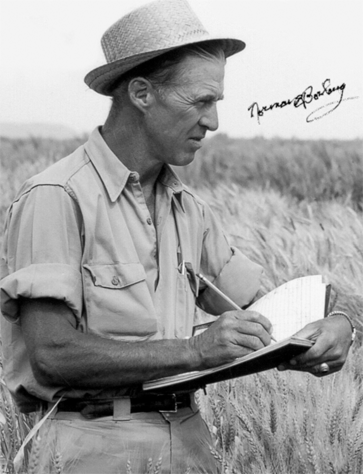
A Tribute to the Man who Fed the World: Dr. Norman Borlaug

Norman Ernest Borlaug
(March 25, 1914 – September 12, 2009)


The Father of Green Revolution has died at his home in Dallas, Texas on 12th Sept, last Saturday at the age of 95. If not for this legend, most of us would not have been here today. His efforts in increasing crop yields have saved hundreds of millions of lives around the world. It has been said the Borlaug saved more lives than any other person in history. For this he received the Nobel Peace Prize in 1970. And he is the only person to have won a Nobel in agriculture so far. Borlaug was also one of five people to have won the Presidential Medal of Freedom, and the Congressional Gold Medal, which is the highest US civilian medal.

In 1944, when many parts of developing countries were facing the threat of mass starvation due to rapid increase in population, Borlaug began his work at a project funded by Rockefeller Foundation in Mexico to increase wheat production. He successfully developed wheat with a sturdy, short stalk that could hold the high-yielding grain on top. He was also able to build in fungal resistance trait in this wheat against wheat stem rust. There wasn’t a short-cut in developing these varieties. Borlaug collected wheat strains from the around the world and started cross-breeding them. He worked with two crops a year, a summer crop in the low-quality, high-altitude soils near Mexico City, and a winter crop hundreds of miles to the north in the low-lying Yaqui Valley. This was done to speed up his research.

In five years, Borlaug was able to develop a variety that was resistant to rust , with higher yield and that was able to grow in both climate when given enough fertiliser and water. But because evolution favoured wheat strains with longer and slender stalks, the stalks tended to collapse when irrigated and this reduced the yield. After thousands of unsuccessful attempts to produce a dwarf variety, Borlaug encountered a Japanese dwarf variety. And finally after another thousands of attempts, in 1954 he successfully developed a short-stalked variety that was rust-resistant and high-yielding.

Due to this variety, Mexico was able to become a wheat exporter in the 1960s. In late 1960s, Borlaug, began his work in India and Pakistan. India was importing 10 million tonnes of wheat at that time. Thanks to Borlaug again, with the introduction of the dwarf variety of wheat, India too emerged as a wheat exporter and became self-sufficient. In Pakistan, wheat production increased from 4.6 million tonnes in 1965 to 8.4 million tonnes in 1970. In 1960, the world production of wheat was 692 million tonnes for a population of 2.2 billion. With the introduction of Borlaug’s techniques and varieties, in 1992, the world wheat production rose to 1.9 million tonnes for a population of 5.6 billion. This was achieved in spite of using only 1% more land.

Borlaug strongly felt that food scientists should be recognised with Nobel Prize, but this suggestion struck down by Nobel Prize which led him to establish the annual World Food Prize. Dr. M.S. Swaminathan was the first recipient of this. Most part of his lives was also spent on the argument over the social and environmental consequences of the Green Revolution.

Borlaug also became was a strong advocate of GM crops and often said that the critics of GM are elitists who are rich enough not to worry about where their next meal was coming from.

I am proud to mention here that Dr. Norman Borlaug was a Patron of ISAAA. His contribution and memories will never fade away and he will be truly missed.

By Mahaletchumy Arujanan

Monday, September 7, 2009

Blue Rose: The Impossible


Roses are loved by everyone. It signifies love. But to be precise each colour brings a different meaning and feelings. Red is said to mean love and romance; pink for grace and elegance; yellow for warmth and happiness; white for purity and innocence; orange for desire and enthusiasm; and lavender for enchantment.

So what about blue? Since blue roses do not occur naturally and it was almost impossible to inject a blue gene into a flower, it was synonym to impossible. For a long time breeders have been trying to develop blue rose by crossing rose varieties around the world with no success. So, I would think the most appropriate meaning for blue rose would be ‘impossible and unattainable’.

But thanks to Suntory Limited and Florigene, blue rose was finally developed through genetic engineering. Suntory is based on Osaka and owns 98.5% of Florigene which is based in Melbourne. Just this year the Australia’s Gene Technology Regulator has granted a licence to Florigene for the commercial release of this rose.

It was a challenge to develop blue rose as blue gene is a rarity in the flora kingdom. The enzymes responsible for the blue pigment in the rose are flavonoid 3’5’-hydroxylase from Viola tricolor and anthocyanin 5-acyltransferase from Torenia hybrida. Viola tricolor is a common European wild flower, while Torenia bybrida is commonly known as wishbone flower. These two enzymes give rise to the blue pigment in the flower petals called delphinidin.


Although the rose is not of navy blue colour but is blue enough to be called blue rose. Suntory is currently conducting more research to make blue roses “bluer”. This also serves as a starting point to create blue pigment in various other flowers as well as more varieties in rose colour.

The flower industry is a blooming industry. In the 1950s, the global flower trade was less than US$3 billion and had grown to US$100 billion in 1992. Holland is the number producer of flowers but the emergence of new producers is now transforming Holland from a producer to a trader. Colombia is the second largest exporter of flowers in the world and others are Ecuador, Ethiopia, Kenya and India.

Malaysia, with her varieties of orchids can certainly set her eye in capturing a small share in the floriculture business. Research has been going on in enhancing orchid colours and lengthening shelf life. Hope to see some commercialization in this area which will create a good job market and contribute towards our GDP.

By Mahaletchumy Arujanan

Friday, August 28, 2009

Where will the Dengue Fever Vaccine come from?


Dengue has been killing hundreds of people each year and the numbers is not going down. We have all been advised to spend 10 minutes every week to clean the pots and other mosquito breeding places around our houses. What else can we do? Is this enough to curtail the problem? Is cleaning around the house enough to deprive these creatures from breeding? Months ago we heard about the sterile male mosquitoes developed through GM technology which was supposed to be released to Pulau Ketam for a field trial. But thanks to the opponents of the technology, it did not materialise.

How about developing vaccines? What is the progress in this area? As a tropical country plagued with various tropical diseases, perhaps we should have a Centre for Research on Tropical Diseases. But again, will this answer the question and provide a solution? Who will head the centre? Who will set its direction and ensure it objectives and mandates are met? How will the funding be channelled? Do we have enough researchers to run it?


To save us all these troubles, Acuvax, a South-Australian based vaccine development company has announced that the dengue fever vaccine is set to begin phase I safety trials in the US through its affiliate company, Hawaii Biotech. This is the first recombinant subunit vaccine for dengue to enter clinical studies. The phase I study will lead to the initial clinical testing of Hawaii Biotech’s tetravalent dengue fever vaccine.

Isn’t that good news? Once the vaccine is approved for use, we can all say good-bye to dengue fever. But do not complain when we have to pay these multinationals premium prices for the vaccine. And do not also sing the same old song that multinationals are monopolising the industry. And for those who are against GM technology, please keep away from this vaccine. You might never know the risk... It is just easier and safer to clean around the house... just 10 minutes every week!

So to answer my question on where the dengue vaccine will come from, probably not from a country that is plagued by dengue. The developed countries know which tree to bark. There is huge potential in this vaccine with a huge marketplace.

If we are serious about our commitment to advance biotechnology and look into the priority areas that will benefit the nation and the people, we need to quickly sit down and analyse what is stopping us from moving forward. What are the stumbling blocks? Human capital? Brain drain? Politics? Getting the right people? Fund management? Perseverance?

Millions of dollars have been pumped into this research. Terra Rossa Capital has injected up to US$1.25 million in equity capital in the ACU subsidiary Acuvax Immunology Services. This is just part of the investment. The total investment to develop this vaccine is certainly much bigger. Could we have afforded this? Perhaps, yes. Looking at the amount spent on Antarctic and Space programmes, we can safely say we have the money. It is again barking the right tree!

By Mahaletchumy Arujanan

Friday, August 21, 2009

Into the industry: the leap of faith


Of late MABIC has been getting some enquiries by Monashians who want to know about their prospects in the biotechnology industry. I have to apologise on behalf of all of us, as we were in the midst of a few major projects and we could not provide too much time for them to answer all their queries. They have been very concerned that when they come out, they graduate with a degree that leads them nowhere, and leaves them hanging in other less than ideal jobs in contrast to other industries like finance, IT etc. One of the major reasons is that, biotechnology being "non-traditional" doesn't really allow one to fall back on the usual strategies like sifting through newspapers or asking elders for advice. Many students realise after a year or two of studying biotech, that research is not their cup of tea. And they feel their future is doomed as they are not aware of the various opportunities that lie ahead of them with a degree in biotech. It is pure ignorance to think biotech graduates all end up as researchers. This is where they need to be exposed more to the biotech industry and the whole spectrum of career available in there.


Of course, lately, there has been much improvement in this sense, with graduates being offered training programmes like that of the BeST programme by BiotechCorp, and internships, as I noted in my last post, as well as bio-career fair during 25 Apr 09 to 26 Apr 09. It makes you wonder why students are still jittery over where they would end up, and what job prospects they would have in the long run.

Primarily, I think universities should take a more proactive role, by organising career talks not only general ones on how to write resumes and go for interviews, but real industry dialogues where students are allow greater interaction with industry players on their expectations, hopes and fears. At MABIC, we are planning a talk soon to address this issue at Monash, in hopes that students would get a better idea on what they should be expecting when they leave the hallowed confines of the ivory tower. On the other hand, it would also be shock therapy to them for them to find that some of their expectations might fall flat. For example, I remember some planning to earn RM3000-4000 per month as a fresh grad, when a more realistic range would be RM1,600-2,500.

I also am concerned on whether the students know enough to search for further information if they are in doubt. Bio-career was a big event organised by BiotechCorp, and graduating students should be attending to have a good gauge of what is waiting for them out there, instead of sitting in the darkened lecturer theater waiting for people to spoonfeed them with such information. If all else fails, google is just a click away and with their capabilities in searching through wikipedia to help them with their homework, why not use it to help them with their jobs.


To try and limit the scope of what careers in biotech is about is pretty silly, as biotech is vast that it would be plain impossible to try to define a single category of jobs. Graduates can apply jobs ranging from marketing to sales, research, science writing, and regulatory, just to name a few. I also know several close friends who end up out of the biotech field, and they are very happy with what they do. The scope is limitless and it only boils down to what one has a stronger preference for. I for one cannot envision myself sitting in a research lab analysing samples, while others may find my line of interviewing and writing on science issues intimidating. All I can say is, keep your eyes and ears open. If all fails, google is your friend. :) I will update on the bio-career dialogue soon. Until then.

- KC, Liew